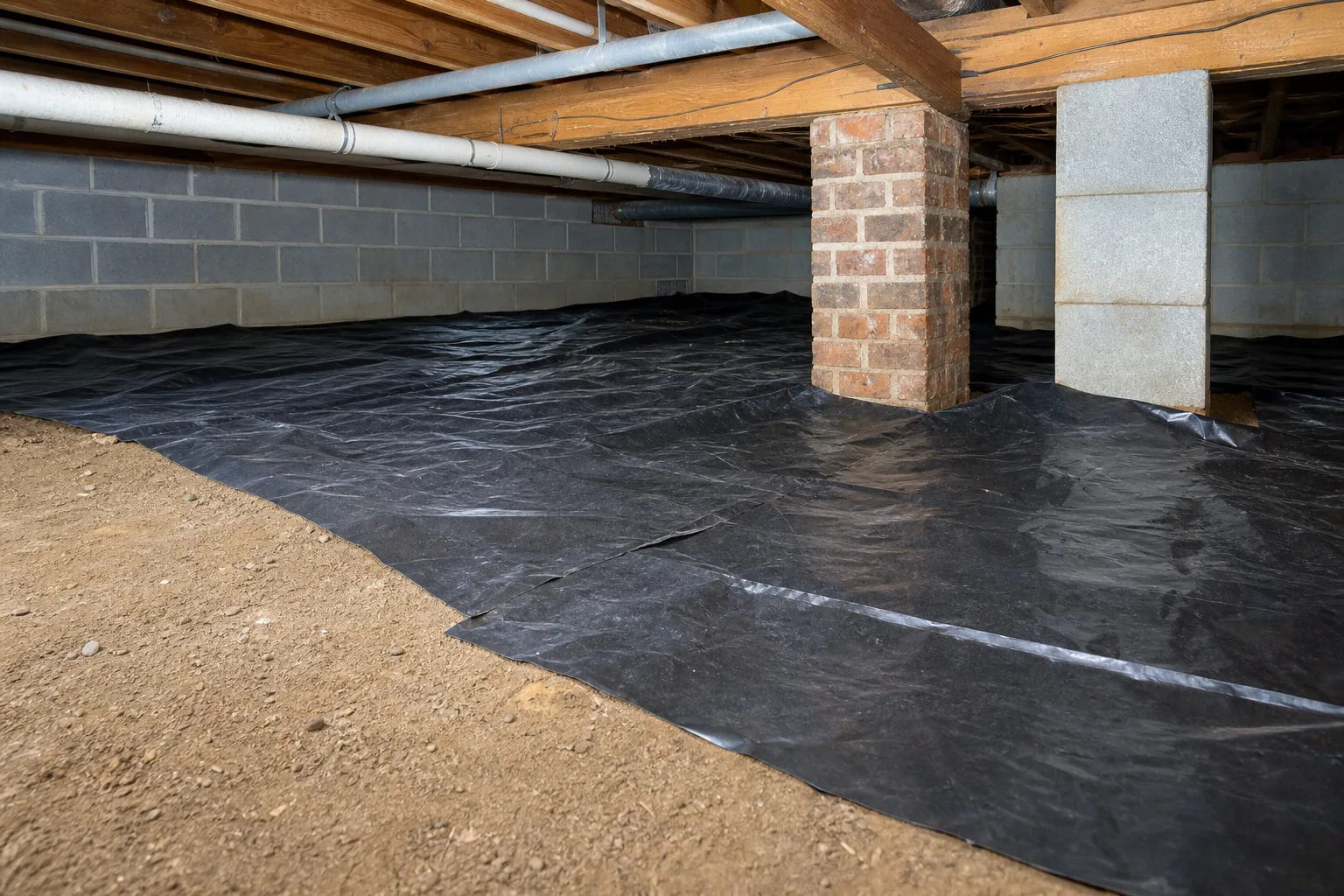
1 · The half system: vents sealed, nothing drying the air
This is the most common failure by a wide margin, and the easiest to spot on a quote. A vented crawl space at least exchanges air with outside. Seal the vents and lay a liner and you have a closed box sitting over ground that still gives off moisture, with no mechanism to remove it. Humidity can settle higher than it was before the work.
The building code treats this as one requirement, not an option: an unvented crawl space needs a ground vapor retarder and one of four ways of handling the air — continuously operating mechanical exhaust, conditioned air supplied from the house, a dehumidifier sized for the space, or the crawl space run as a supply plenum. In the humid Southeast the answer is usually a dehumidifier.
Ask: "Which of the four does this scope use, and what capacity?" A quote that seals vents, installs liner and stops has not answered it — and the difference is typically $800–$1,600, which is also why it goes missing. Sizing a dehumidifier.
2 · A liner laid over an active water problem
A vapor retarder stops soil moisture from evaporating upward. It does nothing about liquid water arriving from bad grading, a disconnected downspout, a high water table or a slow plumbing leak. Water that arrives after the liner is down pools on top of the soil beneath it, lifts sections of it, and sits there — out of sight, which is worse than before, because the thing that used to tell you (a damp smell, visible mud) is now under plastic.
The tell in a quote is sequence. A legitimate scope names the moisture source as a finding first — "negative grade at the north wall", "downspout discharging at the foundation", "standing water after rain, no perimeter drain" — and prices the correction separately from the encapsulation. A quote that jumps straight to liner and dehumidifier has skipped the diagnosis, whatever the salesperson said in your kitchen.
3 · Gas appliances left in a space you just sealed
If your water heater or furnace sits in the crawl space and draws its combustion air from that space — an atmospherically vented appliance, the kind with an open draft hood rather than a sealed intake pipe — then tightening the space around it changes the conditions it was installed under. Combustion appliances need makeup air, and a depressurized enclosure can cause a draft hood to spill exhaust instead of sending it up the flue. That is a carbon monoxide question, and it deserves a straight answer.
There are three legitimate resolutions: the appliance is already sealed-combustion and unaffected; the scope provides combustion air to the enclosure; or the appliance is relocated. What is not a resolution is nobody raising it. Ask for a combustion safety test after the work, in writing, and keep a CO alarm on the floor above regardless.
Radon belongs in the same conversation and gets the same treatment: test before, test a few months after, and add sub-membrane depressurization if the result comes back above the EPA action level. Encapsulation is not a radon system, and neither "it fixes radon" nor "it causes radon" is something a salesperson can know without a test.
4 · The termite inspection strip, covered
Termite inspection depends on being able to see the foundation wall and the sill area, where mud tubes show up. Run the liner all the way up and seal it over that band and you have hidden exactly the surface an inspector reads. Pest control agreements commonly require a clear inspection strip — often around three inches below the sill — and a crawl space that no longer has one can put a termite bond in dispute at the worst possible moment, which is after damage.
This is a five-minute phone call to your pest company before the crew arrives, and it is worth making yourself rather than delegating it. Get their requirement in writing, hand it to the encapsulation contractor, and make the detail part of the scope. A contractor who works in your market regularly will already know the answer; one who waves the question off is telling you something.
5 · The dehumidifier nobody drains
A crawl space dehumidifier pulls water out of the air continuously through a Southeast summer, and that water has to go somewhere. The failures are mundane and common: a condensate line run to nowhere in particular, a pump with no float switch, a line that freezes or clogs, a filter nobody has reached in three years. The result is a unit that quietly stops keeping up, or worse, discharges into the crawl space it was installed to dry.
The check is simple and you can do it yourself twice a year: look at where the condensate line terminates, confirm water is actually leaving there, read the humidity on a hygrometer you placed (not the unit's own display), and pull the filter. A reading that holds around 50–60% through August is the whole point of the system; a reading that climbs is the system telling you something before the wood does.
6 · The warranty that isn't what it sounded like
"Lifetime warranty" is doing a lot of work in this industry. Three details decide whether it means anything: whether it transfers to the next owner and at what fee, whether it depends on an annual paid inspection you may not remember to book, and which legal entity is behind it. That last one is the quiet failure — the name on the warranty, the name on the contract and the name on the insurance certificate are not always the same, and a warranty from an entity that no longer trades is a piece of paper.
You can check the entity yourself. State licence records and insurance certificates name a legal entity; compare it character for character against the one signing your contract. That comparison is one of the checks on every listing we publish — each with the date it was run and a link to the record in the directory, or do it yourself with the licence guide.
What a complete scope looks like
The drying method is named
Dehumidifier, conditioned supply air, mechanical exhaust or plenum — one of them, on the quote, with a capacity or CFM figure.
The moisture source is diagnosed before the liner
Grading, gutters, drainage or humid air — stated as a finding, with the corrective work priced separately.
Combustion appliances are addressed
Either they are sealed-combustion, or the scope includes combustion air, or they are relocated. A post-work combustion safety test in writing.
The termite inspection strip is left visible
The liner stops short of the sill; your pest company has confirmed the detail in writing.
Condensate has somewhere to go
Gravity drain or a pump with a float switch, terminating outside the crawl space — not a bucket, not the ground under the liner.
The warranty says who, how long, and what voids it
Transferability, annual service requirements, and the legal entity behind it matching the entity on your contract.
Holding a quote right now? Run it through the free quote checker for the missing-line-item patterns, and compare the number against what other homeowners were quoted for the same square footage.
Frequently asked questions
▸Can crawl space encapsulation make things worse?
Yes, in specific and predictable ways. Sealing the vents without installing something to dry the air leaves a closed box over damp ground, and humidity can sit higher than it did when the space was vented. Covering an active water problem with a liner hides it rather than fixing it. And sealing a crawl space that contains an atmospherically vented gas appliance can interfere with how that appliance draws combustion air. Each of these is a scope failure, not an argument against encapsulation — a complete system does not have them.
▸Do I need a dehumidifier after encapsulation?
You need one of the four things the code recognizes for an unvented crawl space: continuously operating mechanical exhaust, conditioned air supplied from the house, a dehumidifier, or the space run as a supply plenum. In the humid Southeast a dehumidifier is the usual answer. What matters is that the quote names which one it is. A quote that seals vents and installs a liner and nothing else has left that question unanswered.
▸Why is there water under my new vapor barrier?
Because the liner is a vapor retarder, not a drain. It stops soil moisture evaporating upward; it does nothing about liquid water arriving from grading, gutters, a high water table or a plumbing leak. Water arriving under a sealed liner pools and can lift it. The fix is upstream — grading, downspout extensions, a footing drain or an interior drain to a sump — and it belongs in the scope before the liner goes down, not after.
▸Will encapsulation void my termite bond?
It can, and this is the one to check before the crew arrives rather than after. Termite inspections rely on seeing the foundation wall and sill area, so a liner run all the way up and sealed over that band can hide the mud tubes an inspector looks for. Common practice is to stop the liner short of the sill and leave a clear inspection strip — often about three inches. Ask your termite company what their agreement requires and get the answer in writing before anyone bands liner to the top of the wall.
▸Does encapsulation affect radon?
Sealing the ground reduces the paths soil gas uses, which usually helps — but a sealed crawl space is also more connected to the air in the house, and encapsulation is not a radon system. The honest sequence is to test before, test again a few months after, and if the result is above the EPA action level, add sub-membrane depressurization. Any contractor who tells you encapsulation is a radon fix, or that it makes radon worse, is stating something only a test can answer.
▸How do I know if my encapsulation was done right?
Three checks, none of which need a specialist. A hygrometer left in the crawl space should read roughly 50–60% relative humidity across a humid month. The liner should be sealed at seams and up the walls, with the inspection strip left visible. And the dehumidifier, if you have one, should have a condensate line that actually drains somewhere and a filter you can reach. Photos in the closeout report should show your crawl space, not stock images.
Sources & how we know
International Residential Code R408.3 — unvented crawl space requirements
EPA — radon testing and mitigation guidance
Advanced Energy — closed crawl space field studies (North Carolina)
2025–2026 contractor quotes and closeout reports reviewed across NC & SC (CrawlCred internal)