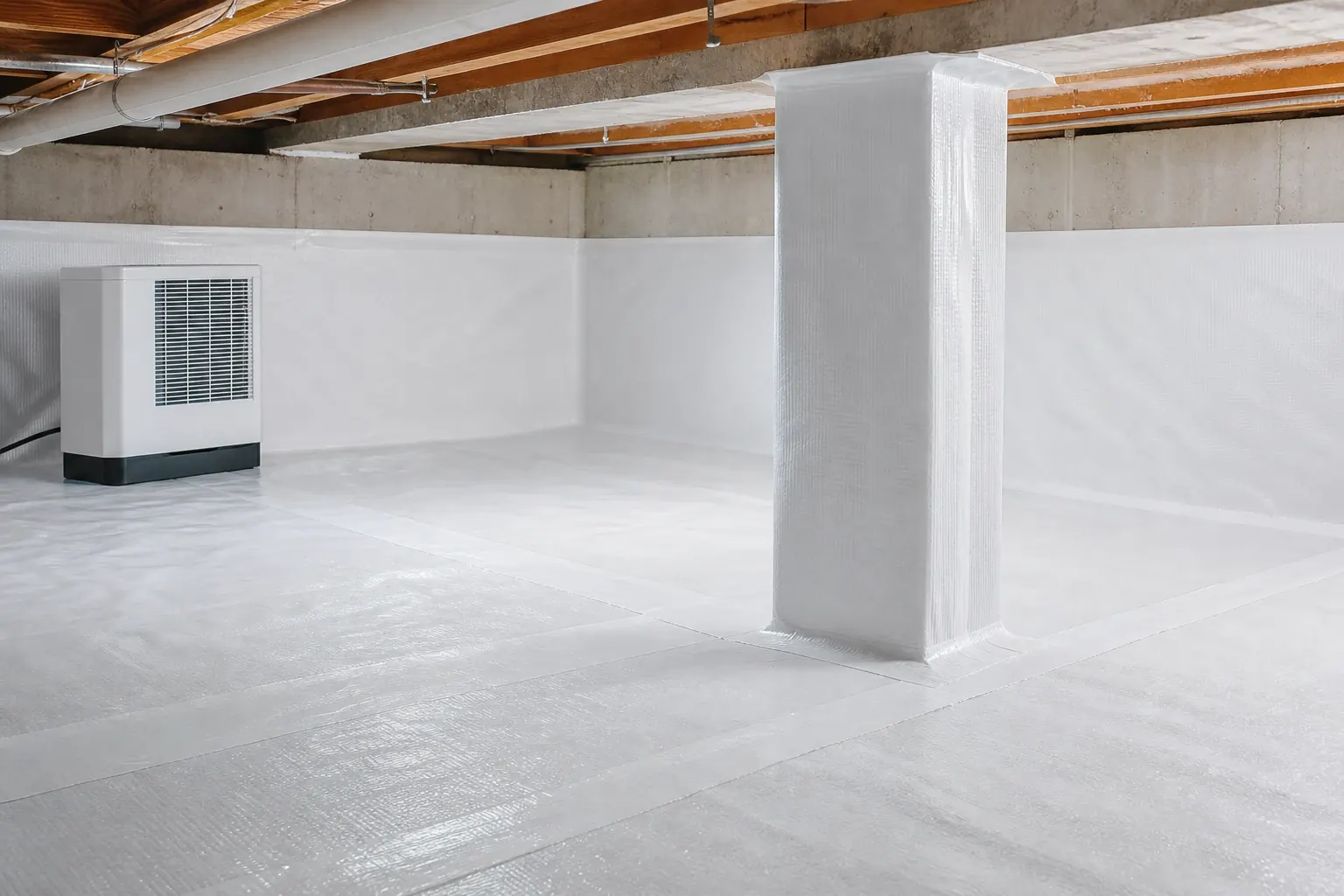
Cost by line item
| LINE ITEM | TYPICAL RANGE | WHAT TO KNOW |
|---|---|---|
| Inspection / assessment | $0–$400 | Free inspections are sales visits — fine, but treat the 'findings' as a pitch. Independent assessments run $150–$400 and pay for themselves on big jobs. |
| 6-mil vapor barrier only | $1,500–$4,000 | Ground-cover polyethylene, seams overlapped and taped. The budget fix for dirt-floor moisture where air humidity isn't the driver. |
| Full encapsulation (12–20 mil) | $4,000–$14,000 | Heavy liner up the walls, sealed vents and penetrations, taped seams. Price scales with footprint ($5–$8/sq ft is the common band) and access difficulty. |
| Dehumidifier | $800–$1,600 installed | Sized to the space (usually 70–120 pints/day). Coastal homes should spec corrosion-resistant units. |
| Interior drainage + sump | $1,500–$3,500 | Required where groundwater enters. Encapsulating over standing water is the most common misdiagnosis we see in quotes. |
| Insulation (walls or floor) | $1,000–$3,500 | Closed crawl spaces usually insulate foundation walls with rigid foam instead of floor batts. |
| Mold remediation | $1,500–$4,000 | Surface treatment of framing. Should include moisture-source correction or it will return. |
| Structural repair (sills, joists) | $2,000–$10,000+ | The wide-open line item. Insist on photos of the specific members being replaced and per-member pricing. |
What moves the price
Four things explain most of the spread between two honest quotes:
- Footprint & access. Bigger spaces cost more per job but less per square foot; low clearance and tight hatches add labor.
- Liner spec. 12-mil reinforced is the residential standard; 6-mil sheeting is builder-grade and tears. The mil number belongs in the contract.
- Water management. If groundwater enters, drainage comes first — sealing over standing water treats the symptom.
- Region. Coastal humidity, high water tables and termite rules (an inspection gap at the wall top) all change the scope.
Quote patterns that signal padding
- One number, no line items. A single "crawl space system: $12,800" makes comparison impossible — that's its purpose. Ask for the breakdown; refusal is your answer.
- Everything, everywhere, all at once. Encapsulation + sump + dehumidifier + full insulation + mold treatment on every quote regardless of conditions. Real assessments differ house to house.
- Today-only pricing. A discount that expires when the salesperson leaves is a pressure tactic, not a price. Verified pros' quotes hold for weeks.
- Deposits over a third. Materials for a typical job don't justify 50% down.
- No moisture diagnosis. If the quote doesn't say whether the problem is groundwater (drainage) or air humidity (sealing + drying), the scope is a template — probably the expensive one.
Run any quote you already have through the free quote checker — it flags these patterns and generates the questions to ask.
The comparison that saves the most
Across the quotes we review, the same scope routinely differs 30–40% between two legitimate local companies. Two verified quotes cost you one extra phone call and save four figures more often than any negotiation tactic.
Frequently asked questions
▸How much does crawl space encapsulation cost on average?
Full encapsulation typically lands between $4,000 and $14,000 in the Southeast, with $5–$8 per square foot the common band before add-ons like drainage or structural work. A ground-only vapor barrier is cheaper ($1,500–$4,000) but solves a different problem.
▸Why do quotes for the same house vary so much?
Because they're usually quoting different scopes — one is a vapor barrier, another adds sealing, a third adds drainage and a dehumidifier. Itemized quotes make the differences visible; the same true scope still varies 30–40% between two legitimate companies, which is why a second quote pays off.
▸Is a cheap encapsulation quote a bad sign?
Not automatically — but confirm what's missing. Below about $4/sq ft usually means a thinner liner, unsealed seams or no drying mechanism. Cheap-because-efficient and cheap-because-incomplete look identical on the total line; only the line items tell them apart.
▸How much deposit should I pay upfront?
One-third or less is the working norm, with the balance on completed, inspected work. Materials for a typical job don't justify 50%+ down; a large deposit shifts the contractor's cash-flow risk onto you.
Sources & how we know
2025–2026 contractor quotes reviewed across NC & SC (CrawlCred internal)
Advanced Energy — closed crawl space field studies (North Carolina)