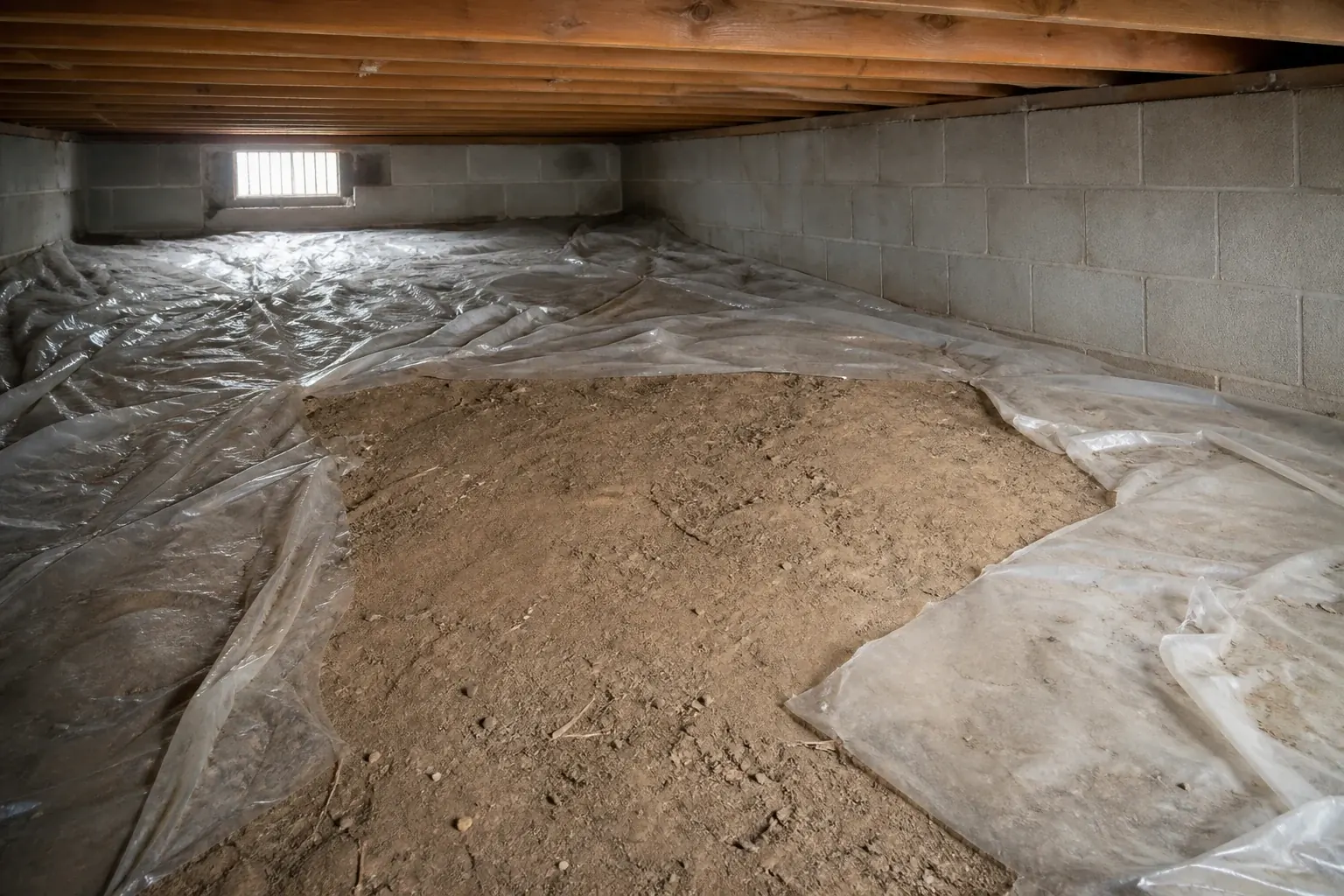
Why crawl spaces grow mold
Mold needs three things: organic material (your floor joists and subfloor are food), spores (always present in outdoor air), and moisture. You can't remove the wood or the spores — moisture is the only lever. Sustained relative humidity above roughly 60%, or wood moisture content above about 19%, is when growth activates. A Southeast crawl space with open vents in July routinely crosses those lines, which is why the problem is regional and seasonal, not random.
The real risk, stated honestly
Two things are true at once. First, mold in a chronically damp crawl space is a genuine building-health issue: it signals moisture that can degrade framing over time, and because a large share of first-floor air rises from the crawl space, a musty air path reaches the living space. Second, the "toxic mold will poison your family" framing common in sales visits overstates the typical acute medical risk for healthy adults.
People with asthma, allergies, or compromised immunity are more sensitive and should take it more seriously. For everyone, the responsible response is the same: identify the moisture source, fix it, clean what's there — and ask for lab evidence before accepting any claim framed as a health emergency.
Mold vs. its lookalikes
- Surface mold: fuzzy, splotchy, often white/green/gray/black patches on damp wood. Wipes into the surface texture.
- Efflorescence: a white, crystalline crust on masonry piers or walls — it's mineral salt left by evaporating water, not mold. Often sold as mold.
- Old staining / dust: flat discoloration that doesn't grow. A moisture reading and, if it matters, a lab sample tell them apart cheaply.
A pin-type moisture meter reading on your joists (ask to see the number) is the fastest objective check — above ~19% is the line that matters, and a pro carries the meter.
The right fix — in the right order
- 1 · Find and stop the water. Grading, gutters, drainage for liquid water; identify whether the driver is ground or humid air.
- 2 · Clean the existing growth. Surface treatment of affected framing — reasonable once the source is being addressed.
- 3 · Hold the humidity down. The right moisture-control scope (vapor barrier, or sealing + a dehumidifier) keeps conditions below the growth threshold so it doesn't return.
Notice the order: remediation is step two, and it's worthless without steps one and three. Any quote that leads with "kill the mold" and never names the moisture source has it backwards. Our encapsulation vs. vapor barrier guide helps you match the moisture-control scope to your actual source.
Scare-tactic tells to watch for
“Black mold — toxic — your family is in danger.”
Why it's a tell: “Black mold” isn't a species; color doesn't establish toxicity, and a lab sample does. Urgency language without a lab report is a sales tell, not a diagnosis.
A remediation quote with no moisture-source fix
Why it's a tell: Killing the mold without lowering the humidity just re-buys the same job in a year or two. The moisture correction is the actual remedy.
“Air quality test” performed and sold by the same crew
Why it's a tell: The party paid to remediate shouldn't be the sole party judging whether you need it. An independent test is the credible one.
Same-day-only pricing on a health emergency
Why it's a tell: Real health hazards don't come with a discount that expires when the salesperson leaves. Fear + a countdown is a pattern.
Got a mold-heavy quote already? Run it through the free quote checker — it flags health-urgency-without-evidence and missing moisture-source line items.
Frequently asked questions
▸Is crawl space mold dangerous?
For most people, mold in a sealed-off crawl space is a building-health issue (it means chronic moisture and can affect the wood and the air rising into the house) more than an acute medical emergency. People with asthma, allergies or immune conditions are more sensitive. 'Toxic black mold' claims deserve a lab report, not a sales pitch.
▸How do I know if it's really mold?
Surface mold looks fuzzy or splotchy and grows on damp wood; efflorescence (white mineral crust on masonry) and old dust or staining are commonly mistaken for it. If it matters for a decision, a lab sample settles it — and it's cheap relative to a remediation quote.
▸Can I remove crawl space mold myself?
Small surface spots on accessible framing can be cleaned, but the point is moot if the humidity that grew it stays high — it returns. The durable fix is lowering moisture (drainage / sealing / drying), which is also what a legitimate contractor leads with.
▸Will encapsulation get rid of mold?
Encapsulation removes the conditions mold needs by holding humidity low, so it prevents regrowth — but existing growth should be cleaned first, and only if a moisture source is actually driving it. Sealing a genuinely dry space to 'stop mold' is solving a problem you may not have.
▸How much does crawl space mold remediation cost?
Surface treatment of framing typically runs $1,500–$4,000, but that number is meaningless without the moisture correction beside it. Treat any mold quote that doesn't name and fix the water/humidity source as incomplete.
Sources & how we know
EPA — Mold course & moisture-control guidance
Advanced Energy — closed crawl space field studies (North Carolina)
2025–2026 contractor quotes reviewed across NC & SC (CrawlCred internal)